
Decoding Why Dogs Bark: Identifying Triggers and Medical Factors

Excessive barking training works best when you manage environmental triggers, withhold the attention or access that rewards the vocalization, and consistently reinforce calm alternative behaviors like settling on a mat or offering a quiet chin rest. This combination addresses the root cause rather than just suppressing the sound, and it gives your dog a clear, rewarding path back to quiet.
Canine vocalization is a natural form of communication. When barking becomes constant, it usually signals an underlying emotional state or a reinforced habit rather than bad behavior. Dogs bark for distinct reasons, and identifying the root cause is the foundation of any successful training plan.
Common behavioral triggers include:
- Alert and Territorial Barking: Triggered by sights and sounds outside the home, such as delivery trucks, postal workers, passing dogs, or neighbors walking by windows.
- Demand Barking: Used to gain immediate access to attention, food, play, or outdoor breaks. The dog learns that making noise makes humans move.
- Barrier Frustration: Occurs when a dog is restricted by a leash, window, baby gate, or fence line and cannot interact with something exciting or stressful.
- Fear and Anxiety: Vocalizations accompanied by tense posture, pinned ears, or avoidance behavior when facing unfamiliar stimuli.
- Separation Distress: Repetitive, persistent vocalizing that begins shortly after you depart, often paired with pacing, panting, or destruction.
- Boredom and Under-Stimulation: Monotonous, repetitive barking that occurs when a dog lacks physical movement and mental challenges throughout the day.
Before treating noise as purely behavioral, it is critical to rule out medical factors. Sudden increases in vocalization, especially in older dogs or previously quiet companions, can stem from physical pain, orthopedic discomfort, sensory decline, or cognitive changes. If a dog experiences joint stiffness or systemic discomfort, their tolerance for environmental stress drops dramatically. Reviewing practical guidance on managing barking triggers and browsing our informative blog articles for dog training can help you evaluate your dog's daily routines while your veterinarian checks for any physical issues.
Why Punishment-Based Approaches Backfire
When living with persistent barking, reaching for quick fixes like citronella spray collars, ultrasonic noisemakers, or electronic shock collars can be tempting. However, punishment-based tools carry significant behavioral risks and do not resolve the underlying reason your dog is vocalizing.
Punitive devices suppress the outward symptom without addressing the emotional trigger or teaching your dog what to do instead. When a dog receives an unpleasant shock or blast of spray while looking at a passing person, they often associate that pain with the stranger rather than their own vocalization. This can turn simple alert barking into intense fear or defensive aggression. Furthermore, punishment spikes stress hormones like cortisol, elevating baseline anxiety across the board.
In multi-dog households, automated bark-deterrent devices create collateral damage. If one dog barks and an ultrasonic device activates, every dog in the room receives an aversive correction, creating confusion, tension, and social conflict between household pets.
| Feature | Positive Reinforcement Training | Punishment-Based Tools (E-Collars, Sprays) |
|---|---|---|
| Primary Mechanism | Rewards alternate calm behaviors and changes emotional associations | Applies an unpleasant stimulus to suppress vocalization |
| Long-Term Reliability | High; builds sustainable self-regulation and impulse control | Low; often leads to habituation or sudden behavioral fallout |
| Impact on Stress | Lowers baseline anxiety and builds canine confidence | Elevates cortisol, fear, and defensive reactivity |
| Multi-Dog Safety | Safe for all pets; builds a peaceful home dynamic | Risky; non-barking dogs receive accidental punishment |
| Skill Acquisition | Teaches the dog clear, desirable alternative behaviors | Suppresses sound without offering functional alternatives |
The Science of Extinction in Excessive Barking Training
Demand barking operates on the laws of operant conditioning. A dog barks, an owner looks over, talks, offers a toy, or opens the back door, and the barking behavior is reinforced. Because attention of any kind satisfies the dog's goal, even telling your dog "no" or sighing loudly counts as a rewarding interaction.
To resolve demand barking, we apply operant extinction alongside differential reinforcement of an alternative behavior. Extinction involves permanently removing the specific reward that maintains the behavior. If the dog barks for attention, all attention stops the second the vocalization begins. You turn away, avoid eye contact, and remain still until silence returns.
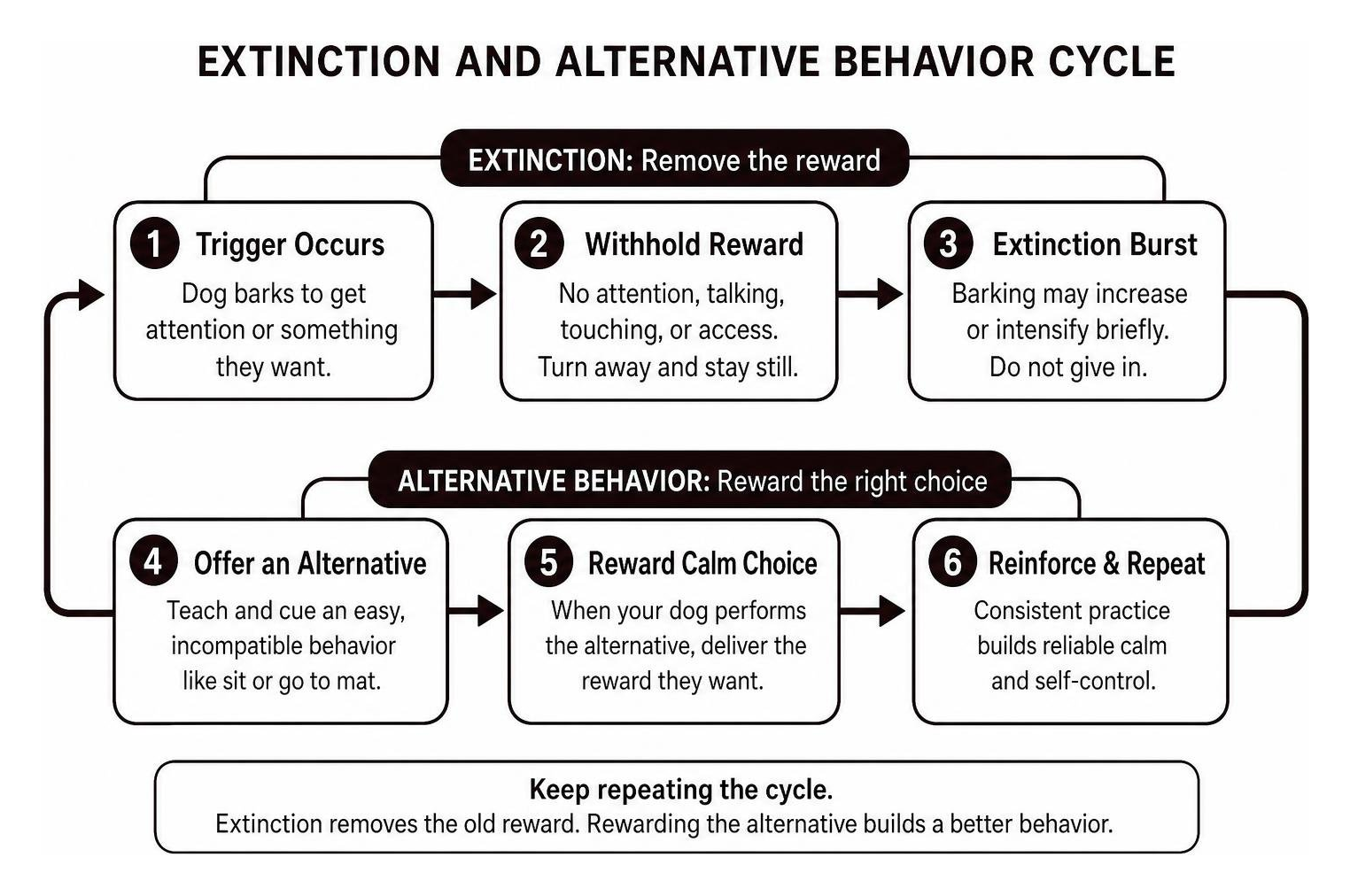
Simply ignoring the bark is only half the solution. Ignoring without providing guidance creates frustration. We must pair extinction with an easily achievable alternative behavior that yields the exact reward the dog was seeking. This methodology is supported by clinical research on extinguishing demand barking and reflects our positive philosophy for dog training.
Navigating the Extinction Burst Without Giving In
When you stop rewarding a previously successful behavior, your dog will not immediately give up. Instead, they will experience an extinction burst.
An extinction burst is a temporary surge in the intensity, duration, and frequency of the behavior. Think of pressing an elevator button: if the doors do not open on the first push, you push the button repeatedly and harder before looking for stairs. Your dog does the same thing. During the first four days of consistent reward withdrawal, expect your home to get louder before it gets quieter.
The danger during an extinction burst is giving in. If your dog barks for ten minutes straight and you finally toss a toy to get relief, you have accidentally taught your dog that extreme persistence pays off. This creates an intermittent reinforcement schedule, making the barking habit much stronger and harder to unravel. Every member of the household must respond consistently every single time.
The Role and Limits of Calming Routines
Many owners look into calming supplements with ingredients like chamomile, ashwagandha, or L-theanine to help manage barking. While these ingredients can support nervous system regulation and help take the edge off high baseline arousal, they are not a cure for barking habits.
Calming routines and supplements serve as supportive adjuncts. They can help bring an over-aroused dog into a calmer state where learning is possible, but they will never replace structured environmental management and hands-on skill building.
Proactive Management and Teaching Alternative Behaviors
Managing your home environment stops the constant rehearsal of barking habits. Every time your dog practices barking at a trigger, the neural pathways for that behavior strengthen. Management buys you time to teach new habits safely.
Proactive management includes:
- Applying static-cling frosted window film to lower window panes so your dog cannot track outdoor movement.
- Keeping curtains drawn during peak delivery times.
- Moving furniture away from windows that serve as lookout perches.
- Setting up white noise machines or soft classical music near entryways to mask outdoor sounds.
- Bringing dogs inside rather than leaving them unattended in the yard where fence-line barking thrives.
Alongside physical management, ensure your dog's daily biological needs are thoroughly met. A tired brain and body naturally vocalize less. We recommend a minimum of 60 minutes of daily physical exercise, ideally working toward 90 minutes for energetic breeds, paired with decompression sniff walks and food puzzle toys. For structured guidance on meeting these developmental milestones, explore our comprehensive dog training programs.
Core Protocols for Excessive Barking Training at Home
Building alternative responses relies on short, clear micro-sessions lasting between 30 and 90 seconds, practiced several times throughout the day.
1. The Quiet Cue
To teach a reliable quiet cue, catch a moment of natural pause during an alert bark. Hold a high-value, aromatic treat directly in front of your dog's nose. Because a dog cannot sniff and bark simultaneously, they will pause. Wait for two seconds of complete silence, mark with a calm "yes," and deliver the treat. Gradually increase the duration of silence required from two seconds to ten seconds before adding the verbal cue "quiet."
2. The Chin Rest
A physical chin rest provides an incompatible behavior for barking. When a dog rests their chin flat on your hand, an ottoman, or your knee, their mouth is occupied and their emotional state shifts toward focus. Reward your dog for placing their chin in your open palm for one second, then build duration up to thirty seconds of sustained contact.
3. Go to Place (The Hot Zone)
Designate an elevated bed, mat, or distinct rug as your dog's safe station.
- Walk your dog to the mat and lure them into a down position.
- Deliver several small treats directly between their paws while they remain lying down.
- Release with a cue like "free."
- Practice sending your dog to their mat from across the room, rewarding sustained relaxation with calm praise and long-lasting chew items.
Targeted Solutions for Doorbell, Window, and Alone Barking
Different barking contexts require specific handling:
- Doorbell Reactivity: Record your actual doorbell chime on your phone. Play the sound at barely audible volumes while tossing treats to your dog on their place mat. Gradually increase the audio volume across several days until the chime becomes a clear cue to run happily to the mat rather than rushing the front door.
- Window Barking: Pair visual barriers with rapid redirection. If your dog notices a person through an open gap, use a happy kissy noise or treat scatter on the floor to draw their focus away before barking begins, rewarding them for turning back toward you.
- Barking When Left Alone: Establish calm departure routines. Avoid dramatic goodbyes and practice leaving for micro-durations of five seconds, thirty seconds, and two minutes while your dog enjoys a frozen lick mat. Build predictability by varying departure cues so picking up your keys does not trigger anticipatory panic.
A Step-by-Step Week-by-Week Road Map to Success
Transforming ingrained barking patterns requires patience, consistency, and clear tracking. By focusing on achievable weekly targets, you can steadily build long-term calm.

A 6-Week Plan for Excessive Barking Training
- Week 1: Baseline Logging and Environmental Management
- Keep a daily log of every barking incident, noting the time, trigger, barking duration, and your response.
- Install window film, white noise machines, and baby gates to block visual and auditory triggers.
- Ensure your dog receives daily exercise and enrichment.
- Week 2: Full Extinction Implementation and Reward Withdrawal
- Commit to zero attention for demand barking across all household members.
- Prepare for the extinction burst during days one through four. Keep interactions neutral and silent during barking episodes.
- Reward spontaneous moments of quiet relaxation throughout the day.
- Week 3: Introducing Replacement Cues
- Begin 60-second micro-sessions teaching the chin rest and the go to place protocol.
- Reward your dog for offering these silent behaviors instead of barking when they want something.
- Barking bursts should begin decreasing to just a single bark before your dog tries their new replacement behavior.
- Week 4: Distraction Proofing and Trigger Desensitization
- Introduce low-volume doorbell recordings and controlled outdoor distractions.
- Reward your dog on their place mat while low-level triggers play in the background.
- Practice impulse control games like wait at doorways and leave it.
- Week 5: Duration and Distance Building
- Send your dog to their mat from greater distances within the home.
- Increase the duration of required silence before rewarding alert bark pauses.
- Practice stepping outside the front door for brief intervals while rewarding quiet waiting.
- Week 6: Real-World Generalization and Maintenance
- Test new skills with real visitors, delivery arrivals, and routine phone calls.
- Maintain predictable routines and continue reinforcing calm choices spontaneously.
- Enjoy holding conversations and quiet evenings with your dog resting peacefully at your feet.
When to Seek Professional In-Home Support
While consistent home training resolves most barking habits, some situations require specialized behavioral intervention. If your dog's vocalization is driven by severe panic, separation anxiety resulting in physical self-injury, intense fear, or escalating reactivity toward visitors, professional guidance is essential.
In-home coaching allows a behavioral expert to evaluate the specific layout of your home, identify hidden environmental reinforcers, and design a customized modification plan tailored to your family's daily life. You can explore our customized in-home day training lessons and schedule a consultation through our contact page to receive hands-on help right where the barking happens.
Frequently Asked Questions About Dog Barking
Is demand barking the same as separation anxiety barking?
No, demand barking and separation anxiety barking stem from entirely different emotional states and motivations. Demand barking occurs while you are present; the dog vocalizes purposefully to get you to provide food, toys, attention, or access outdoors, and the barking stops immediately once they get what they want.
Separation-related barking occurs when you leave or when your dog is isolated from you. It is driven by distress and panic rather than an intentional request. It is often accompanied by pacing, heavy panting, drooling, house soiling, and destructive behavior directed at doors or windows, and it does not stop because no human is there to reward it.
How long does it take to see noticeable results from barking training?
Most dog owners who consistently manage triggers, withdraw accidental rewards, and reinforce alternative behaviors see measurable improvement within two to six weeks.
During the first several days of training, expect vocalizations to temporarily increase during the natural extinction burst. By week three, barking episodes typically drop to short, brief vocalizations as your dog defaults to alternative behaviors like sitting or going to their mat. By week six, calm behaviors become automatic habits when routines are maintained.
Should I tell my dog "quiet" or yell "no" when they bark?
You should avoid yelling "no" or shouting commands when your dog is actively barking. When you yell, your dog often interprets your loud, energized voice as you joining in on the vocalization, effectively turning it into a group barking session.
Additionally, if your dog is barking for attention, any verbal response delivers the exact engagement they were seeking. Instead of yelling, calmly withdraw your attention for demand barking, or use a neutral sound to redirect alert barking toward a designated station where you can reward their silence.
Building a Calmer Home Through Positive Training
Excessive barking can test any household's patience, but it is important to remember that barking is a form of communication rather than deliberate defiance. By taking the time to decode your dog's specific triggers, eliminating accidental reinforcement, and patiently teaching practical alternative skills, you can restore peace and quiet to your living space.
Humane, science-backed training deepens the trust between you and your pet while building lifelong emotional regulation. If you live in Chesterton, Valparaiso, Michigan City, or surrounding communities across Northwest Indiana and Southwest Michigan and are ready for hands-on guidance, Life of Riley Dog Training is here to support you. We provide personalized positive-reinforcement training services directly in your home, complete with lifelong support to ensure your dog thrives as a calm, confident, and well-mannered family companion.