
Basic Commands for Puppies: Where to Start
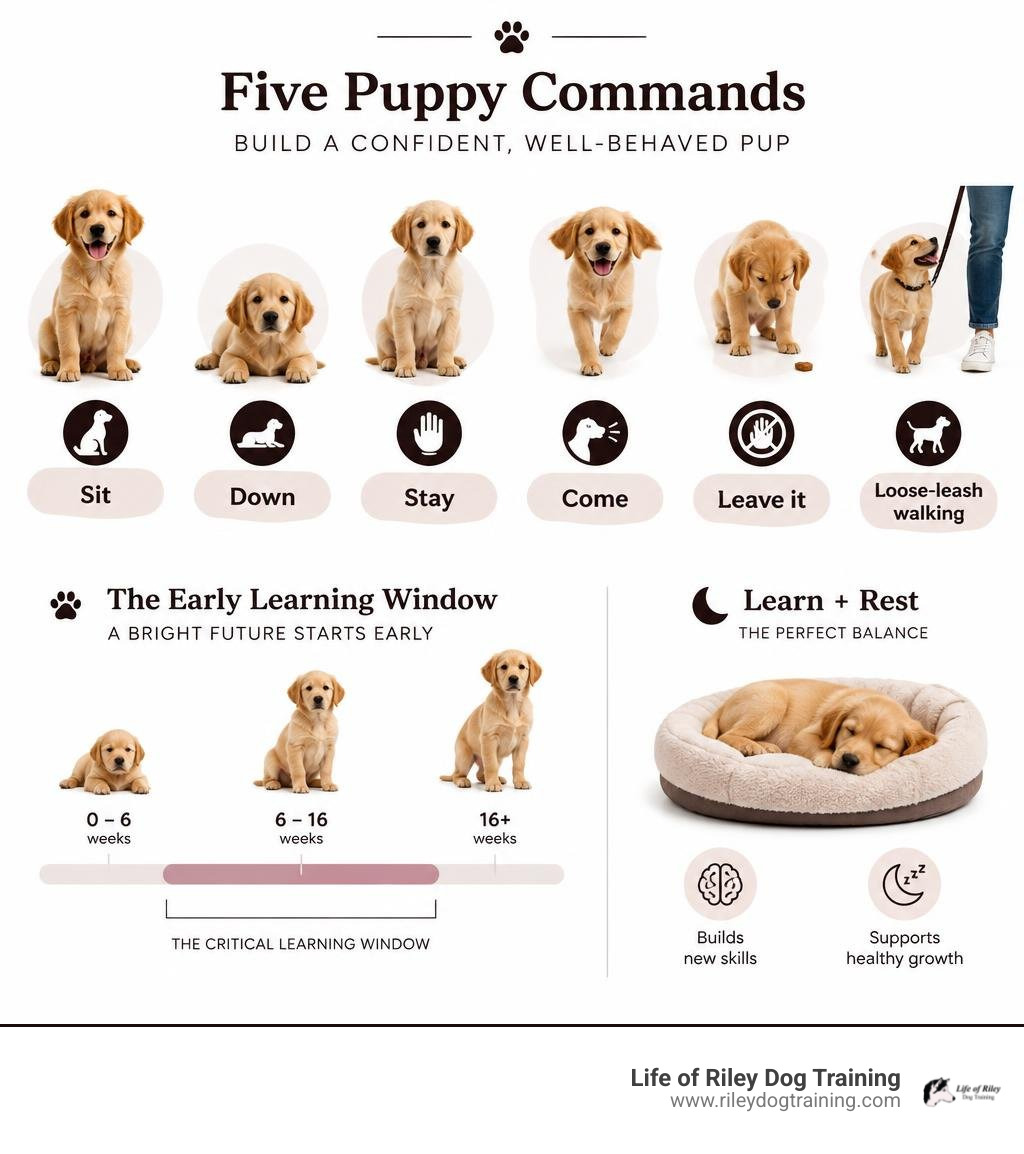
Start with sit, down, stay, come, and leave it. These five cues help your puppy settle, respond to you, and avoid hazards. Add loose-leash walking as soon as your puppy is comfortable wearing a leash.
You can begin when your puppy comes home, often around 8 weeks old. Practice for a few minutes at a time in a quiet spot. Reward each success right away, and build on what your puppy can already do. Early training matters, but there is no need to rush. Puppies also need plenty of rest.
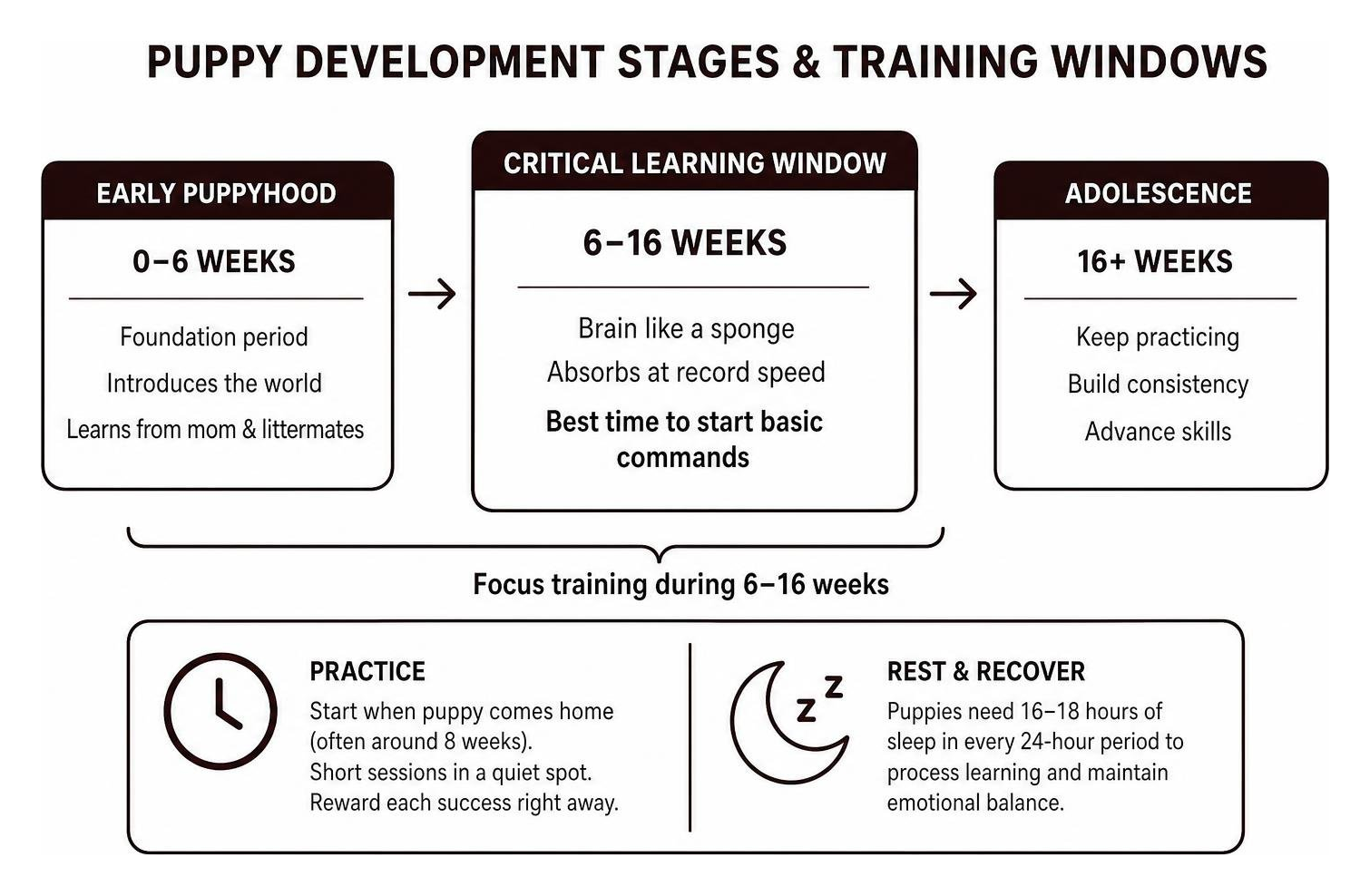
Bringing a young pup home brings boundless joy, soft cuddles, and an unmistakable whirlwind of energy. That early puppyhood chaos is completely natural. Between 6 and 16 weeks of age, your puppy experiences a critical learning window where their brain acts like a little sponge, absorbing information about their world at record speed.
At the same time, growing bodies need immense recovery time. Puppies require 16 to 18 hours of sleep in every 24-hour period to process what they learn and maintain emotional balance. Striking the right harmony between gentle practice and ample rest sets the stage for a lifetime of wonderful companionship.
The Core Foundations for Teaching Basic Commands for Puppies
Before jumping into individual cues, setting up the right learning environment ensures that training feels like a delightful game rather than a chore. Dogs learn best through positive reinforcement, which means we reward behaviors we want to see more often while preventing unwanted habits from taking root. You can explore our philosophy for dog training to see how positive, relationship-focused methods build lasting trust.
To make communication crystal clear, professional trainers rely on precise marker signals. A marker is a distinct sound, such as a clicker or a cheerful word like "Yes!", that pinpoints the exact millisecond your puppy performs the correct action. The marker bridges the gap between the behavior and the reward, telling your puppy, "That exact choice just earned you a prize!"
When rewarding your puppy, keep these essential principles in mind:
- Treat Sizing: Use soft, high-value treats cut down to the size of a pencil eraser. Small treats prevent your puppy from getting overly full and keep practice flowing smoothly without lengthy chewing breaks.
- Capturing vs. Luring: Luring involves using a treat right at your puppy's nose to guide their body into position. Capturing means waiting for your puppy to offer a natural behavior on their own, such as lying down to rest, and marking it instantly.
- Session Length: Young attention spans are brief. Keep sessions between 3 and 5 minutes for puppies under 12 weeks old, and 5 to 10 minutes for puppies between 3 and 6 months old.
- The Release Word: Every stationary cue needs a clear end point. Introducing a cheerful release word like "Free" or "Okay" tells your puppy when they are finished with an exercise and permitted to move.
For additional insight into standard cue structures, the AKC guide to foundational puppy cues offers valuable background on how positive instruction shapes early learning.
Step-by-Step Guide to the Essential Puppy Obedience Commands
Teaching cues in a logical sequence sets your puppy up for success. We begin with stationary, natural positions before moving on to impulse-control exercises and distance work.
As your puppy gains confidence, fade out food lures quickly. If a treat stays in your hand every time, the puppy learns to look for the food before deciding to respond. Instead, transition that guiding motion into an empty hand signal, rewarding with a treat from your pocket or pouch after the puppy completes the movement.
1. Sit: Starting Basic Commands for Puppies on Day One
Sit is often the quickest behavior to teach because it works naturally with canine body mechanics. When a puppy's head tilts up and back, their rear end naturally moves toward the floor.
How to Teach It:
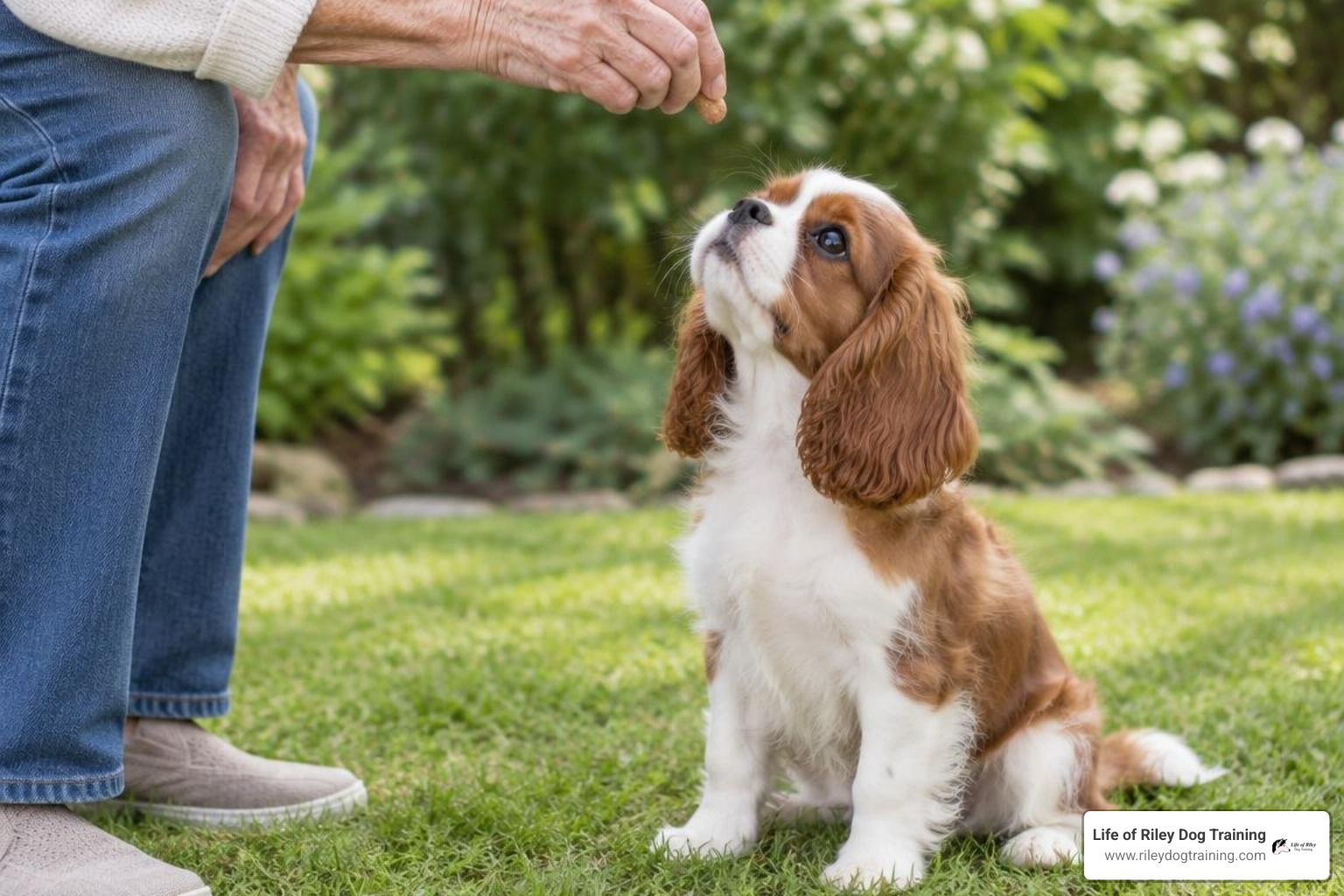
- Hold a small treat between your fingers and place it right in front of your puppy's nose.
- Slowly move your hand upward and slightly back over their head toward their ears.
- As their nose follows the treat upward, their bottom will lower to the floor.
- The moment their rear touches the ground, say your marker word ("Yes!") and deliver the treat immediately.
- Release them with your release word ("Okay!") and take a step back.
Most puppies understand the mechanics of sitting within one to two weeks of consistent, short daily practices. Never push down on your puppy's hips or back. Physical pressure can create confusion or discomfort, whereas letting them find the posture on their own builds genuine confidence.
2. Down: Encouraging Calmness and Relaxation
The "down" command teaches your puppy to settle their entire body on the floor. Lying down is an inherently relaxed posture, making this cue fantastic for preventing unwanted jumping and helping an overexcited pup reset.
How to Teach It:
- Ask your puppy to sit.
- Hold a treat at their nose, then slowly lower your hand straight down between their front paws toward the floor.
- Once your hand is flat on the ground, gently slide the treat forward along the floor like an imaginary "L" shape.
- As your puppy stretches forward to follow the scent, their elbows will drop to the floor.
- Mark the exact moment their elbows touch down ("Yes!") and feed the treat while they remain lying flat.
- Give your release cue to let them know the exercise is complete.
If your puppy stands up instead of lowering their body, do not pull the treat away quickly. Keep your hand close to their chest and lower it slowly so they do not feel the urge to step forward.
3. Stay: Developing Duration and Impulse Control
Stay teaches your puppy impulse control by asking them to remain in place until you give permission to move. We always teach duration (holding still) before adding distance (stepping away).
How to Teach It:
- Ask your puppy to sit or lie down.
- Present a flat hand signal like a gentle stop sign in front of their chest and say "Stay."
- Pause for just two seconds while standing directly in front of them.
- If they remain still, mark ("Yes!"), step in, and deliver a treat directly to their mouth so they do not break position to reach it.
- Say your release word ("Okay!") to invite them to move.
- Gradually increase the time by a few seconds before you begin adding steps backward.
| Puppy Age | Realistic Stay Duration | Typical Distance | Distraction Level |
|---|---|---|---|
| 8 to 10 Weeks | 2 to 5 seconds | Directly in front (0 steps) | Quiet living room, no toys |
| 11 to 16 Weeks | 10 to 30 seconds | 1 to 3 steps away | Mild household movement |
| 4 to 6 Months | 1 to 2 minutes | Across the room | Normal daily activity |
| 6+ Months | Several minutes | Out of sight / outdoor settings | High distractions, outdoor park |
4. Come: Life-Saving Basic Commands for Puppies
A dependable recall is one of the most critical safety skills your dog will ever learn. It allows your pup to explore safely while giving you peace of mind that they will return whenever called.
How to Teach It:
- Start in a quiet hallway or room with minimal distractions.
- Crouch down to make yourself welcoming, open your arms, and call your puppy's name followed by a cheerful "Come!"
- Use a high-pitched, enthusiastic tone. You can make gentle kiss noises or clap your hands to encourage them.
- As they run toward you, praise them warmly.
- Gently take hold of their collar with one hand while feeding several high-value treats with the other. This ensures they associate being held by the collar with wonderful rewards rather than playtime ending.
Never call your puppy to you to deliver a correction, administer medication, or end fun abruptly. If you need to do something your puppy dislikes, walk over and collect them gently rather than poisoning your recall cue. For foundational safety exercises, reviewing the AKC official basic obedience manual offers additional helpful structure.
5. Leave It: Protecting Your Pup From Dangerous Hazards
Curious puppies explore the world with their mouths. The "leave it" cue teaches self-control by asking your puppy to willingly turn away from an enticing item, whether that is dropped food, toxic plants, or sidewalk trash.
How to Teach It:
- Place a moderately interesting treat inside your closed fist and present your hand to your puppy.
- Your puppy will likely sniff, lick, or paw at your hand to get the treat. Stay completely still and quiet.
- The moment your puppy pulls their nose away or stops pawing, mark ("Yes!") and reward them with a different, higher-value treat from your opposite hand.
- Repeat until your puppy immediately backs away when your fist appears.
- Add the verbal cue "Leave it" just before presenting your fist.
- Progress to placing treats under your shoe on the floor, rewarding your puppy whenever they look up at you instead of trying to get the treat.
6. Loose-Leash Walking: Enjoyable Walks Without Pulling
Walking together should be a relaxing experience. Puppies naturally want to forge ahead to explore new smells, so we must teach them that staying near our side is where great things happen.
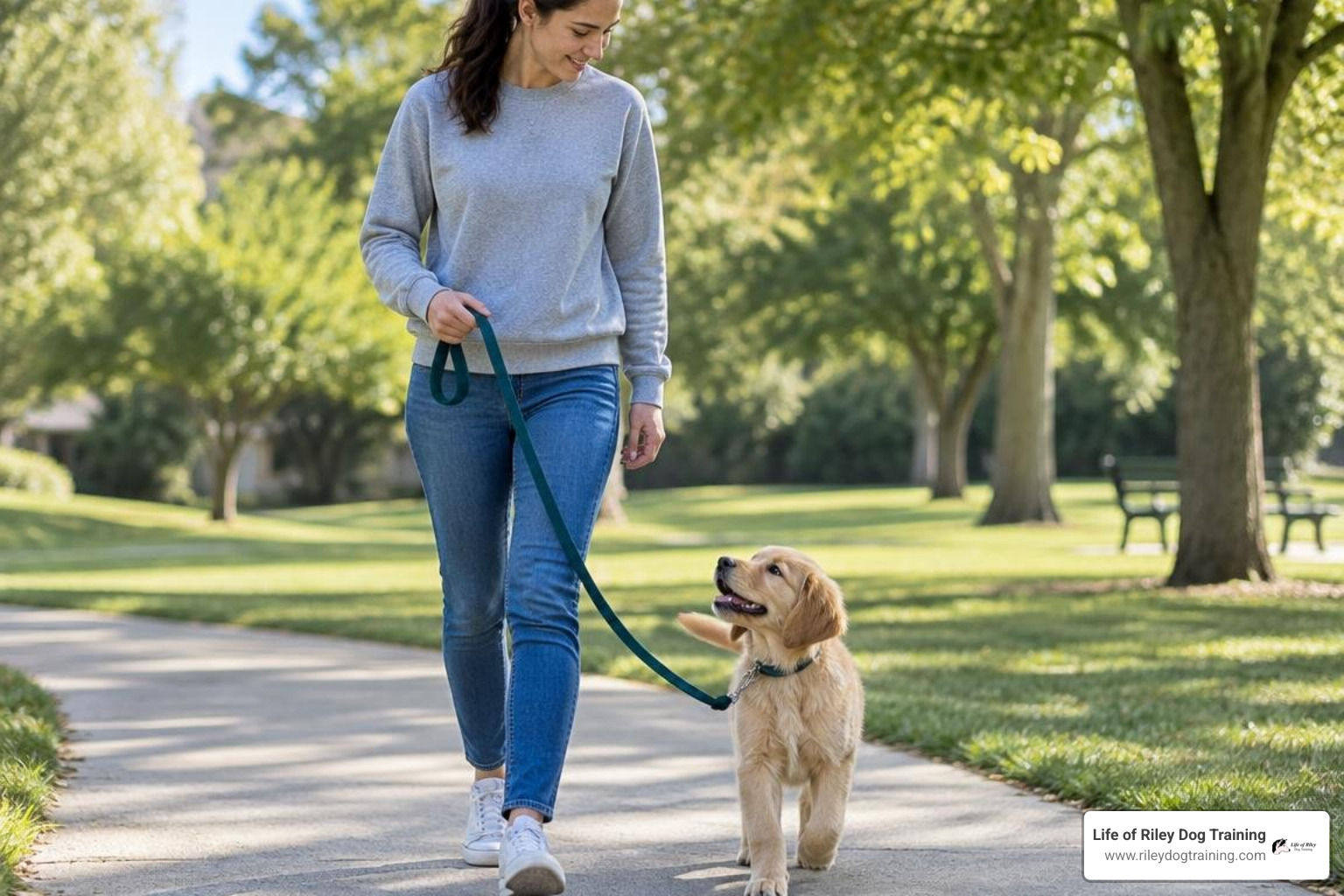
How to Teach It:
- Begin indoors where there are no outdoor distractions like squirrels or passing neighbors.
- Stand with your puppy on your preferred side, holding the leash loosely in a soft "J" loop.
- Take one or two steps forward. The moment your puppy walks alongside your leg at knee level, mark ("Yes!") and deliver a treat right next to your seam line.
- If your puppy rushes ahead and hits the end of the leash, stop moving completely. Become an immovable tree.
- Wait for your puppy to turn back or loosen the tension. As soon as the leash goes slack, praise them, encourage them back to your side, and resume walking.
Troubleshooting Common Puppy Training Roadblocks
When a puppy seems distracted or unresponsive, pet parents often worry their dog is simply stubborn. In reality, puppies are rarely stubborn; they are usually confused, overstimulated, or overtired.
If your puppy struggles to engage, try these practical adjustments:
- Increase Reward Value: Dry kibble works well in a quiet kitchen, but outdoor environments or new challenges require higher-value rewards like tiny bits of plain roasted chicken or string cheese.
- Check the Clock: If your puppy has been awake for more than an hour, their brain might be running on fumes. An overtired puppy often displays frantic biting, zoomies, or total lack of focus. A quiet nap in their crate or pen is often the best solution.
- Lower the Criteria: If your puppy cannot hold a 10-second stay, step back to 3 seconds. Build success in small, confidence-boosting layers.
- Pair Training with Socialization: Exposing your puppy to new sights, sounds, and surfaces during training helps them generalize commands in real-world settings.
For more real-world tips on handling common behavioral puzzles, browse our collection of practical training blog articles.
Frequently Asked Questions About Puppy Training
What is the best age to start teaching puppy commands?
You can start teaching foundational commands the day your puppy arrives home, typically around 8 weeks of age. Between 6 and 16 weeks, puppies absorb new patterns and routines with ease. Keep these early exercises brief, joyful, and centered around positive rewards.
What should I do if my puppy will not focus or walks away?
If your puppy disengages mid-session, take it as communication rather than misbehavior. They may be full, tired, or overwhelmed by distractions. Stop the current exercise, ask for one simple behavior they know well (such as an easy sit), reward them warmly, and wrap up the session on a positive note.
Can I teach multiple basic commands to my puppy at the same time?
It is best to focus on one new command at a time during dedicated training sessions. Once your puppy understands the mechanics of a single cue, you can begin introducing another while briefly reviewing previous cues to consolidate their understanding without creating confusion.
Building a Lifetime of Good Habits Together
Teaching foundational manners is an investment in your puppy's safety, happiness, and lifelong relationship with your family. With patient consistency, short sessions, and plenty of celebratory rewards, those chaotic early weeks smoothly transform into polite everyday habits.
If you ever feel overwhelmed or want guided support right in your living room, Life of Riley Dog Training is here to help. We provide personalized, in-home positive reinforcement training tailored to your home environment throughout Chesterton, Valparaiso, Michigan City, and surrounding communities across Northwest Indiana and Southwest Michigan. Our hands-on approach ensures your puppy builds reliable skills where they matter most, supported by our lifelong guidance. Explore our expert dog training programs or transform your puppy with Life of Riley Dog Training to start your pup on the path to becoming their absolute best self.